LTL Freight Class Calculator
Compute US LTL cubic feet, PCF density, and estimated class on both the FCDC 18-tier guideline and NMFTA Docket 2025-1 13-sub scale.
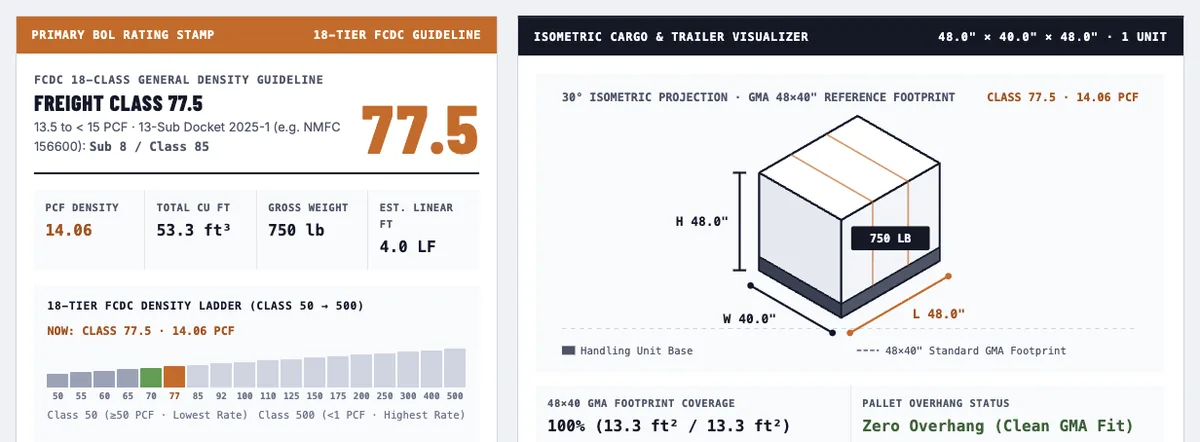
1 PLT | 48x40x48 in | 750 lb | 53.33 cu ft | 14.06 PCF | Est. NMFC Class 77.5
NMFTA Docket 2025-1 13-Sub Commodity Density Scale (Subs 1–13)
Under NMFTA Docket 2025-1 (Disposition Bulletin 1371 Subject 77, effective July 19, 2025), commodities assigned to the standardized 13-sub density scale—such as Plastic Articles NOI (NMFC 156600 in authorized boxes, crates, drums, or numbered packages)—rate across 13 PCF sub-provisions (Subs 1–13, Class 50 through Class 400). Note that Subject 77 displays the NMFTA handling, stowability, and liability (HSL) hand symbol on NMFC 156600 and Articles, NOI provisions to flag packaging and characteristic verification requirements; that symbol does not alter the 13-sub PCF class numbers themselves. By contrast, commodities with packaging-split schedules and HSL identifiers—such as Machinery NOI (NMFC 133300 under Bulletin 1370b) and Air Compressors NOI (NMFC 118100, both updated under Bulletin 1371-1 Subject 3)—do not follow this generic 13-sub schedule; always confirm your exact item, sub-provision, and authorized packaging in ClassIT.
| Sub # | Freight Class | Density Bracket (PCF) | Typical Density-Only Goods |
|---|---|---|---|
| Sub 13 | Class 50 | 50+ PCF | Solid metal parts, dense hardware, heavy castings |
| Sub 12 | Class 55 | 35 to < 50 PCF | Dense metal stampings, compacted industrial goods |
| Sub 11 | Class 60 | 30 to < 35 PCF | Boxed dense components, heavy industrial supplies |
| Sub 10 | Class 65 | 22.5 to < 30 PCF | Hydraulic pumps, boxed power tools, compact assemblies |
| Sub 9 | Class 70 | 15 to < 22.5 PCF | Crated machinery, dense molded plastics (e.g. 18 PCF) |
| Sub 8 | Class 85 | 12 to < 15 PCF | Industrial skids, boxed hardware (e.g. 14.06 PCF) |
| Sub 7 | Class 92.5 | 10 to < 12 PCF | Dense boxed electronics, refrigeration parts (e.g. 10.00 PCF) |
| Sub 6 | Class 100 | 8 to < 10 PCF | Commercial displays, boxed enclosures, light machinery |
| Sub 5 | Class 125 | 6 to < 8 PCF | Small appliances, boxed commercial seating, sheet metal parts |
| Sub 4 | Class 175 | 4 to < 6 PCF | Molded plastic bins, boxed apparel, HVAC ductwork |
| Sub 3 | Class 250 | 2 to < 4 PCF | Empty molded containers, boxed light fixtures (e.g. 2.00 PCF) |
| Sub 2 | Class 300 | 1 to < 2 PCF | Hollow plastic bottles/jars, large light housings |
| Sub 1 | Class 400 | Under 1 PCF | Ultra-light expanded foam, empty thin-wall packaging |
FCDC 18-Class General Density Guidelines (Class 50–500)
The Freight Classification Development Council (FCDC) Procedures publish a general 18-class density guideline spanning Class 50 through Class 500 (including Classes 77.5, 110, 150, 200, and 500 that are not part of the 13-sub commodity schedule). Keep the two tables separate when preparing a Bill of Lading: always verify your specific commodity item in official NMFTA ClassIT before tendering.
| Freight Class | Density Range (PCF) | Typical Commercial Freight | Scale Note |
|---|---|---|---|
| Class 50 | 50+ PCF | Steel fittings, solid metal bar stock, bagged cement | FCDC 18-class guideline · Highest density tier |
| Class 55 | 35 to < 50 PCF | Bricks, hardwood flooring, heavy metal stampings | FCDC 18-class guideline · Heavy palletized goods |
| Class 60 | 30 to < 35 PCF | Bottled beverages, canned foods, boxed auto components | FCDC 18-class guideline |
| Class 65 | 22.5 to < 30 PCF | Boxed books, hydraulic pumps, boxed power tools | FCDC 18-class guideline |
| Class 70 | 15 to < 22.5 PCF | Crated food machinery, car engines, bagged dry ingredients | FCDC 18-class guideline |
| Class 77.5 | 13.5 to < 15 PCF | Tires, bathroom fixtures, boxed commercial hardware | FCDC 18-class guideline (not used on 13-sub commodity scale) |
| Class 85 | 12 to < 13.5 PCF | Crated industrial machinery, cast iron stoves, boxed transmissions | FCDC 18-class guideline |
| Class 92.5 | 10.5 to < 12 PCF | Computer monitors, boxed refrigeration units, dense plastics | FCDC 18-class guideline |
| Class 100 | 9 to < 10.5 PCF | Boxed electronics, commercial displays, wine cases | FCDC 18-class guideline · Mid-scale FAK anchor |
| Class 110 | 8 to < 9 PCF | Cabinets, framed artwork, boxed light metal fabrications | FCDC 18-class guideline (not used on 13-sub commodity scale) |
| Class 125 | 7 to < 8 PCF | Small household appliances, vending machines, boxed office chairs | FCDC 18-class guideline |
| Class 150 | 6 to < 7 PCF | Auto sheet metal parts, assembled wooden shelving | FCDC 18-class guideline (not used on 13-sub commodity scale) |
| Class 175 | 5 to < 6 PCF | Boxed apparel, molded plastic bins, upholstered chairs | FCDC 18-class guideline · Below 6 PCF check capacity rules |
| Class 200 | 4 to < 5 PCF | Packaged mattresses, aluminum tables, HVAC ductwork | FCDC 18-class guideline (not used on 13-sub commodity scale) |
| Class 250 | 3 to < 4 PCF | Bamboo/rattan furniture, boxed fiberglass insulation, light fixtures | FCDC 18-class guideline |
| Class 300 | 2 to < 3 PCF | Wood cabinets (set-up), kayaks, trade show booth frames | FCDC 18-class guideline |
| Class 400 | 1 to < 2 PCF | Empty plastic bottles, foam packaging, assembled lampshades | FCDC 18-class guideline |
| Class 500 | Under 1 PCF | Ping-pong balls, ultra-light expanded foam | FCDC 18-class guideline · Highest class (< 1 PCF) |
Worked US LTL Pallet Classification Examples (18-Tier vs 13-Sub)
Notice how identical PCF measurements can map to different classes depending on whether a shipment uses the general 18-class FCDC guideline or a 13-sub commodity item like NMFC 156600. For example, a 48×40×48" skid at 750 lb yields 14.06 PCF—Class 77.5 on the 18-class guideline, or Sub 8 / Class 85 on the 13-sub scale.
| Shipment Scenario | Exterior Dimensions | Gross Weight | Volume | Density | FCDC 18-Class | Docket 2025-1 13-Sub |
|---|---|---|---|---|---|---|
| Standard GMA Pallet — Boxed Hardware | 48" × 40" × 36" | 1,450 lb | 40.00 ft³ | 36.25 PCF | Class 55 | Sub 12 · Class 55 |
| Industrial Skid (48×40×48" · 750 lb) | 48" × 40" × 48" | 750 lb | 53.33 ft³ | 14.06 PCF | Class 77.5 | Sub 8 · Class 85 |
| Boxed Commercial Displays (2 Pallets) | 2 × (48" × 40" × 54") | 1,120 lb | 120.00 ft³ | 9.33 PCF | Class 100 | Sub 6 · Class 100 |
| Assembled Wood Cabinets (Non-Stack) | 48" × 40" × 66" | 340 lb | 73.33 ft³ | 4.64 PCF | Class 200 | Sub 4 · Class 175 |
| Empty Molded Plastic Containers | 48" × 40" × 72" | 145 lb | 80.00 ft³ | 1.81 PCF | Class 400 | Sub 2 · Class 300 |
Open Formulas & B2B Carrier Limitations
What This Calculator Measures
- Exact cubic volume in ft³ and m³ from imperial (in/lb) or metric (cm/kg) inputs.
- Aggregate shipment density across multi-line Bills of Lading plus per-line class checks.
- Separated FCDC 18-class general guidelines (Class 50–500) and Docket 2025-1 13-sub commodity ratings (Subs 1–13, Class 50–400).
- Overhang-preserving GMA pallet allowance (+6" height, +40 lbs per skid).
When Density Alone Is Not Enough
- Fixed NMFC Commodities: Items with specialized handling, stowability, or high liability (e.g., hazardous materials, uncrated glass, delicate electronics) can carry a fixed class higher than density alone. Check the NMFC Code Lookup.
- Carrier FAK Agreements: Negotiated Freight-All-Kinds (FAK) brackets override individual class ratings on contract accounts.
- Length & Capacity Rules: Pieces ≥ 96" long or shipments taking ≥ 12 linear feet incur separate surcharges. Verify with the Linear Feet Calculator.
Frequently Asked B2B Shipping Questions
What is the difference between the FCDC 18-class density guideline and the 13-sub Docket 2025-1 scale?
The FCDC 18-class table is a general density guideline spanning all 18 NMFC classes (50 through 500, including 77.5, 110, 150, 200, and 500). By contrast, NMFTA Docket 2025-1 (effective July 19, 2025) moved many density-only commodities—such as Plastic Articles NOI (NMFC 156600)—onto a standardized 13-sub scale (Subs 1–13, Classes 400 down to 50) with wider PCF brackets. For example, 14.06 PCF maps to Class 77.5 on the 18-class general guideline, but Sub 8 / Class 85 on a 13-sub commodity item.
Should I include the wooden pallet height and weight when calculating freight class?
Yes. US LTL carriers dimension and weigh the complete handling unit as tendered on the dock, including the pallet, stretch wrap, strapping, and any overhang. Leaving off a 40-lb, 6-inch GMA pallet skews PCF density and frequently triggers an automated dimensioner reclass invoice.
What happens when a pallet has cargo overhanging the 48x40 base?
Terminal laser dimensioners measure the widest extreme points of the handling unit, not the wood pallet footprint beneath it. Even 3 inches of carton overhang on two sides expands a 48x40 pallet to 51x43 inches, increasing cubic feet by 14% and often bumping freight into a higher class.
How should I list mixed freight classes on one Bill of Lading?
Itemize each handling unit or commodity group on its own BOL line with separate piece counts, weights, dimensions, and NMFC codes. If you lump mixed-density goods under one generic line item without separate weights, carrier rules tariffs allow rating the entire shipment at the highest class present.
When does a low-density shipment trigger a Cubic Capacity Rule instead of standard class?
Many national LTL carriers enforce a Cubic Capacity or Linear Foot rule once a shipment reaches 750 cubic feet with density under 6 PCF, or occupies 12 or more linear feet of trailer floor. Use our LTL Linear Feet Calculator to check that threshold before tendering.